Free DISC test
We're giving away...
At Profil4, our mission is to promote effective communication and compassionate leadership by helping people better understand themselves and those they interact with (colleagues, clients, partners, interns, friends, family members, etc.) To achieve this, we rely on the DISC model and its associated assessments, a simple, accessible, and powerful tool that helps people understand different behavioral styles and adapt their communication accordingly.
Because we believe this approach should be accessible to everyone, we offer 50 free Essential DISC tests every day to visitors who want to discover the DISC model. Our ambition is to help as many people as possible build stronger relationships, foster better collaboration, and communicate more effectively, both at work and in their personal lives.
So what is it about?
We help managers and their teams discover the strengths of their personalities and communicate better.
The unanimous observation
Everyone is unique and perceives the world from their own perspective. Everyone communicates and behaves in their own unique way.
As a result, we all repeat the same communication mistake: talking to others as we would like them to talk to us. Yet it would be wiser to communicate with them according to their communication preferences.
The golden rule
It is essential to adjust to your interlocutor, which implies knowing and understanding their profile. In long-term relationships, this understanding comes naturally over time. On the other hand, in short-term interactions, it can be more complex.
Good managers do this instinctively. Based on their advice and experience, our specialists were able to determine the main behavioral and communication profiles, leading to the creation of the DISC model.
Identifying P4 profiles
This assessment tool is used to enhance productivity, teamwork and communication skills. It focuses on the analysis of behavioral and communication styles.
It is important to stress that this is not an IQ test. It is not intended to assess intelligence, aptitude, skills, mental health or personal values. Instead, P4 profiles describe human reactions and behaviors in various contexts, such as when they are dealing with stress, facing challenges, in crisis or following procedures...
The goal
A thorough understanding of one's own profile and that of one's contacts is the key to more effective oral and written communication. This knowledge facilitates the appropriate distribution of tasks and objectives and helps identify needs and constraints, among other things. What's more, it can be used to build the right teams by selecting their members according to the context.
What is DISC?
A framework for understanding human behavior.
The DISC in four letters
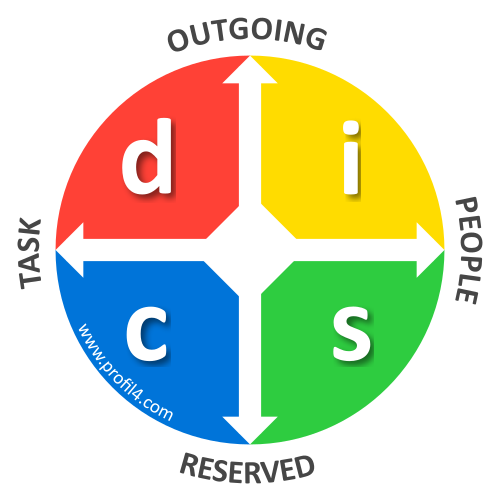
DISC, an acronym for Dominant, Influential, Steady, and Conscientious, is a powerful framework for interpreting and understanding how a person reacts to and interacts with their environment.DISCp4 profiles are typically presented as a wheel divided into four sections, each representing one of the components: Dominant (red), Influential (yellow), Steady (green), and Conscientious (blue). Each section has its own characteristics, but adjacent ones share common traits. For example, Dominant (D) and Influential (I) profiles are generally associated with extroverted traits.
Origins
The model was proposed following the work of psychologist William M. Marston. In 1928, he published "Emotions of Normal People", a work that remains influential, explaining how emotions lead to differences in behavior between individuals and how these behaviors can evolve over time.Marston explained that the expression of emotions could be classified into four primary components, stemming from how a person perceives themselves in relation to their environment. These four components are the ones represented in the DISCp4 wheel.
Adapted vs. Natural
In addition to the four components, the DISC model distinguishes between two behavioral styles.The Adapted style corresponds to our “public self,” that is, the image we project in response to our environment. Jung referred to it as “the mask”: a version of ourselves shaped to fit external expectations, social roles, and situational constraints.
The Natural style reflects our “private self,” that is, the most instinctive part of our personality, which emerges naturally when we are not trying to adapt. It reveals our deeper behavioral tendencies, often unconscious.
Comparative test features
The Essential test is ideal for discovering the DISC model.
The Pro test allows for deeper insight and is particularly suited to professional contexts.
|
Essential |
Pro |
|
|---|---|---|
| Target | Private individuals | Professionals |
| Use | Personal discovery | HR, coaching, training |
| Number of questions | 25 | 70 |
| Test duration | 10-15 min | 15-20 min |
| Results | ||
| Web report An instant, detailed profile view. cf. examples. | ||
| PDF Report Printable, for use in training or coaching sessions as a personal development guide for both individuals and groups. See examples below. | - | |
| Distribution graph The essential graph to illustrate how a profile corresponds proportionally to its main components. | ||
| Trends graph A precise, comparative view of the adapted and natural profiles, in terms of their trends and their magnitude. | - | |
| Advanced study Decision-making, error management, stress management, conflict management, emotions, difficulties, fears... | - | |
| Motivations The BRAPHIS index focuses on the elements most likely to motivate behavior in a given context. | - | |
| Management NEW: Tips for using our managerial tools. | - | |
| Chronoplanning NEW: How someone's chronotype influences the most efficient way to organize their working day. | - | |
| Management | ||
| Test assignment Referrers can assign tests to their colleagues or clients, cf. manuals. | - | |
| Visibility Referrers choose when results will be available for viewing. | - | |
| Workbooks Workbooks can be used to organize profiles according to different criteria. | - | |
| Team graphs The model unleashes its full potential when used in groups. | - | |
| Workbook report Printable summary of team profiles. | - | |
| Start | Start |
Associated Questions
Why do we offer this test?
Our main goal is to introduce you to the DISC model (Dominant, Influential, Steady, Conscientious). With this in mind, we offer 50 free DISC tests to our community each day.
You can also purchase the DISCp4 Essential test at a discounted rate of
Why determine my DISC profile?
Each person perceives their environment, communicates, and acts in their own unique way. Knowing and understanding your own profile, as well as those of the people you interact with, helps make communication and interactions more effective. The DISCp4 tool supports you in this process. You will learn a lot about yourself and may even be surprised.
This test is neither an IQ assessment nor a psychological evaluation. There are no right or wrong answers; the goal is simply to better understand yourself and improve your communication.
Can it be used in a professional context?
The DISCp4 Essential test is intended for individuals who want to discover the DISC model and our services. Its use in a professional or training context is not recommended. For professional use, it is advisable to take the Pro test.
Please refer to the comparison of our plans to choose the one that best suits your needs.
How long does the free test take?
This test includes 25 questions and should take about 10 to 15 minutes. It should be completed in a calm setting, with full concentration. It is important to answer spontaneously and honestly, without overthinking or misleading yourself.
It is recommended to complete it without consulting any documentation beforehand. Explanations will be provided along with your results at the end of the test.